

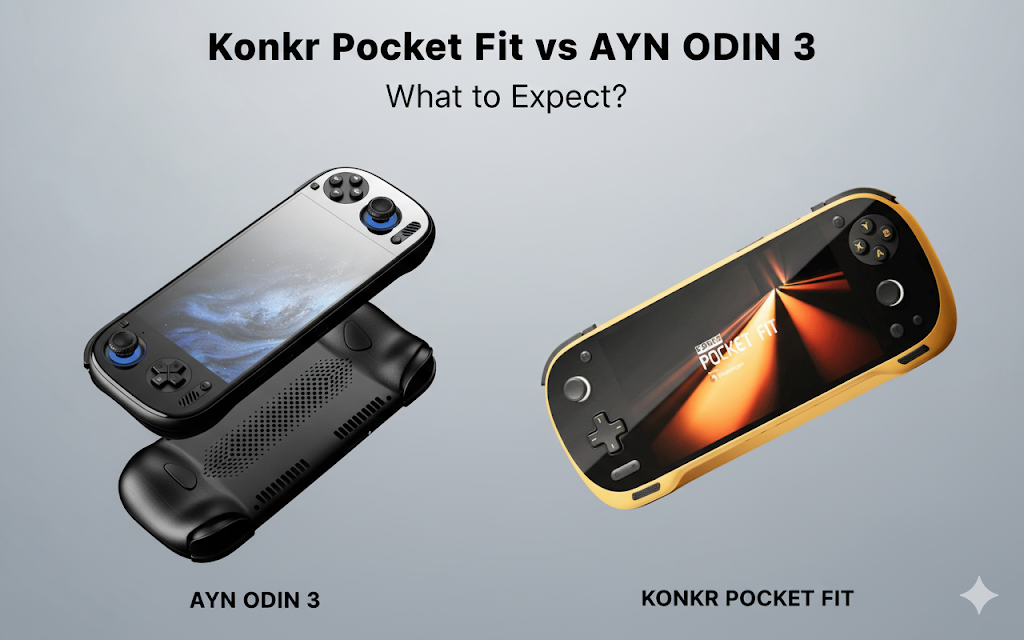
The Android gaming handheld market has reached a fascinating inflection point. With AYANEO’s new Konkr Pocket Fit series and AYN’s Odin 3 all launching with cutting-edge Snapdragon processors, we’re witnessing unprecedented performance at surprisingly aggressive prices. But beneath the spec sheets lies a complex story of driver support, display technology, and strategic trade-offs that will determine which device actually delivers the best gaming experience for your needs.
This comprehensive comparison examines three configurations: the Konkr Pocket Fit with Snapdragon G3x Gen 3, the Konkr Pocket Fit Elite with Snapdragon 8 Elite, and the AYN Odin 3 with Snapdragon 8 Elite. While we haven’t tested these specific devices yet, we can draw reliable conclusions from extensive benchmark data from phones and devices using these same processors.
Quick Specifications Overview
📱 Complete Specifications Overview
Android Gaming Handheld Comparison – 2025 Models
CPU Architecture comparison
📊 Complete Architecture Comparison
| Specification | Snapdragon 8 Elite (SM8750) | Snapdragon G3x Gen 3 |
|---|---|---|
| Design Philosophy | Revolutionary – Clean-sheet redesign NEW | Evolutionary – Refined iteration PROVEN |
| Process Node | TSMC 3nm | TSMC 4nm (inherited from 8 Gen 3) |
| CPU Architecture | Custom 2nd Gen Oryon CUSTOM | ARM Cortex (Licensed) |
| Core Configuration | 2+6 (2 Prime @ 4.47 GHz, 6 Performance @ 3.53 GHz) | 1+5+2 (1 X4, 5 A720, 2 A520) |
| GPU | Adreno 830 (Sliced Architecture) | Adreno A33 (Rebranded 750) |
| GPU Memory | 12 MB GMEM | Standard configuration |
| Ray Tracing | Hardware-accelerated with Global Illumination | Hardware-accelerated (Standard) |
| Power Envelope | Optimized for mobile thermal constraints | Up to 20W sustained |
| Special Features | Unreal Engine 5.3 with Nanite | Mature driver support |
Performance Analysis
Benchmark Performance Expectations
Note: Performance estimates are based on benchmark data from devices using identical Snapdragon processors. Actual handheld performance may vary depending on cooling efficiency and power delivery.
📊 AnTuTu v10 Benchmark Scores
The Snapdragon 8 Elite, found in both the Konkr Elite and Odin 3, represents a generational leap in mobile processing. Based on AnTuTu v10 testing of phones with this chip, we can expect scores around 2.76 million—approximately 32% higher than the G3x Gen 3’s 2.1 million. This translates to meaningful differences in demanding scenarios:
- CPU Performance: The 8 Elite’s custom Oryon cores deliver 44% better multi-core performance
- GPU Performance: 31% improvement in graphics throughput
- Ray Tracing: 31% advantage in next-gen lighting effects
⚡ CPU & Gaming Performance
However, raw benchmarks only tell part of the story. The G3x Gen 3, while “slower” on paper, is built on mature architecture that’s been optimized for years. Think of it like comparing a brand-new sports car that’s still being tuned versus a slightly older model that’s been perfected—sometimes the proven option performs better in real-world conditions.
📋 Complete Benchmark Comparison
All Performance Metrics at a Glance
| Benchmark | SD 8 Gen 2 | SD 8 Gen 3 / G3x Gen 3 | SD 8 Elite | Gain vs Gen 3 |
|---|---|---|---|---|
| AnTuTu v10 Overall | ~1,550,000 | ~2,087,159 | ~2,759,190 | +32.2% |
| AnTuTu v10 CPU | ~380,000 | ~440,975 | ~583,775 | +32.4% |
| AnTuTu v10 GPU | ~600,000 | ~860,385 | ~1,132,574 | +31.6% |
| Geekbench 6 Single-Core | ~1,950 | ~2,183 | ~3,033 | +38.9% |
| Geekbench 6 Multi-Core | ~5,200 | ~6,434 | ~9,271 | +44.1% |
| 3DMark Wild Life Extreme | ~3,764 | ~5,338 | ~6,104 | +14.3% |
| 3DMark Wild Life FPS | ~21 FPS | ~32 FPS | ~40 FPS | +25.0% |
| 3DMark Wild Life Stability | 83.3% | 59.0% | 83.3% | +24.3 pts |
| 3DMark Solar Bay (RT) | ~5,500 | ~8,686 | ~11,397 | +31.2% |
Real-World Gaming Performance
📈 Snapdragon 8 Elite Performance Gains
Percentage Improvement vs G3x Gen 3
Windows PC Game Emulation
This is where the Snapdragon 8 Elite truly shines. Testing from devices with this chip shows remarkable results in Winlator and GameHub:
- The Witcher 3: 40-50 FPS on medium settings (vs 25-30 on G3x Gen 3)
- GTA V: 50-60 FPS in most scenarios (vs 35-40 on G3x Gen 3)
- Red Dead Redemption 2: Actually playable at low settings (barely runs on G3x Gen 3)
The 8 Elite’s brute force advantage is undeniable here—if PC game emulation is your priority, either Elite model delivers a clearly superior experience.
Native Android Gaming
All three devices will max out virtually every Android game available. The performance differences only matter if you’re obsessed with maintaining 144 FPS in competitive titles, where the 8 Elite’s extra headroom helps.
The Emulation Reality Check
Here’s where things get complicated—and where many buyers might make an expensive mistake.
Nintendo Switch Emulation: The Driver Dilemma
Despite the Snapdragon 8 Elite’s superior hardware, it currently performs worse than the G3x Gen 3 for Switch emulation. This isn’t a hardware problem—it’s a software issue.
Community-developed Turnip drivers, essential for Switch emulator compatibility, don’t yet exist for the 8 Elite’s Adreno 830 GPU. Without these drivers:
- Games suffer from graphical glitches and rendering errors
- Many titles crash frequently or won’t launch
- Performance is inconsistent even in “working” games
The G3x Gen 3, using the older Adreno 750-class GPU, has mature Turnip support. This means better compatibility, fewer glitches, and more consistent performance—despite being the “weaker” chip.
Timeline Reality: Based on previous driver development cycles, expect 12-18 months before the 8 Elite gets proper Turnip support. Some community developers have suggested it might never receive the same level of optimization as older chips.
Older System Emulation
For PS2, GameCube, Dreamcast, and earlier systems, all three handhelds are overkill. Any performance differences are academic—everything runs flawlessly.
Thermal Performance Considerations
The Snapdragon 8 Elite draws up to 16W under heavy load—45% more power than the G3x Gen 3’s 11W (correction 20W) peak. In phones, this causes aggressive throttling. While these handhelds include active cooling, we won’t know until retail reviews whether they can sustain peak performance during extended gaming sessions.
This is particularly concerning for the Konkr Pocket Fit Elite, as AYANEO’s promotional materials emphasize its value pricing—suggesting potential cost-cutting in the cooling solution. The Odin 3, given AYN’s track record with the Odin 2, likely has more robust thermal management.
Hardware & Design Differences
Display Technology – The OLED Advantage
The display is the most significant hardware differentiator:
- Konkr Models: 6-inch 144Hz LCD
- Odin 3: 6-inch 120Hz AMOLED
While the Konkr’s higher refresh rate sounds impressive, the practical difference between 120Hz and 144Hz is imperceptible in most games. The OLED’s advantages, however, are immediately obvious:
- Perfect blacks and infinite contrast
- More vibrant, saturated colors
- Better power efficiency when displaying dark content
- Superior viewing angles
For a device you’ll stare at for hours, the Odin 3’s AMOLED is a meaningful upgrade that justifies its price premium.
Build Quality & Controls
All three devices feature:
- Hall effect analog sticks and triggers (drift-proof)
- Active cooling with integrated fans
- Ergonomic grips for extended play
- Premium button layouts
The key differentiator is brand reputation. AYN has proven itself with the Odin 2—excellent build quality, regular firmware updates, and responsive customer support. AYANEO has a mixed track record; their devices often look stunning but suffer from quality control inconsistencies and delayed software support.
Battery Life & Charging
All three pack 8000mAh batteries, but charging speeds differ:
- Konkr Models: 27W fast charging
- Odin 3: 60W fast charging
The Odin 3 charges over twice as fast—a significant advantage for gaming on the go. Battery life will depend heavily on usage, but expect:
- 4-5 hours for demanding emulation
- 6-8 hours for lighter Android gaming
- 2-3 hours running the 8 Elite at full tilt
Software & Ecosystem
Operating System Differences
- Konkr Pocket Fit (G3x): Android 14
- Konkr Pocket Fit Elite: Android 16 (surprisingly forward-looking)
- Odin 3: Android 15
While newer Android versions offer minor improvements, the real software story is community support. The Odin series has an active community creating custom firmware, optimization guides, and game-specific configurations. AYANEO’s devices typically have smaller, less engaged communities.
The Driver Situation Explained
Let’s clarify the driver issue since it’s crucial for informed purchasing:
What are Turnip drivers? Open-source Vulkan drivers developed by the community for Qualcomm GPUs. They include optimizations and bug fixes essential for emulator compatibility.
Why doesn’t the 8 Elite have them? The Adreno 830 is brand new architecture. The volunteer developers are still working on the previous generation (Adreno 750) and won’t start on the 830 until that’s complete.
Current workarounds: Some emulator forks (like Kenji-NX for Switch) work better with stock drivers, but it’s hit-or-miss. You’re essentially beta testing if you buy an 8 Elite device expecting perfect emulation today.
Price & Value Analysis
Current pricing (subject to change):
- Konkr Pocket Fit (G3x Gen 3): Starting at $239
- Konkr Pocket Fit Elite: Starting at $269 (early bird) / $329 retail
- AYN Odin 3: Starting at $299
Hidden costs to consider:
- High-speed microSD card: $50-150
- Carrying case: $20-40
- Screen protector: $10-20
- Potential future upgrades if drivers don’t materialize
Buyer’s Guide – Which One Is Right for You?
🎮 Android Gaming Handheld Showdown 2025
Konkr Pocket Fit vs AYN Odin 3 – Complete Comparison
1920 x 1080 LCD
1920 x 1080 LCD
1920 x 1080 OLED!
Excellent Gaming
Top Tier Performance
Top Tier Performance
Full Compatibility MATURE DRIVERS
Driver Updates Pending NO TURNIP YET
Driver Updates Pending NO TURNIP YET
30-40 FPS AAA Titles
50-60 FPS AAA Titles
50-60 FPS AAA Titles
128GB – 1TB Storage
128GB – 1TB Storage 24GB OPTION!
128GB – 1TB Storage 24GB OPTION!
27W Fast Charging
27W Fast Charging
60W Fast Charging 2X FASTER!
✓ Active Cooling
✓ Wi-Fi 7
✓ Android 14
✓ Bluetooth 5.3
✓ Active Cooling
✓ Wi-Fi 7
✓ Android 16
✓ Bluetooth 6.0
✓ Active Cooling
✓ Wi-Fi 7
✓ Android 15
✓ Bluetooth 5.4
Quick Recommendation Guide
Choose Konkr Pocket Fit (G3x Gen 3) if:
- Switch emulation is your primary use case
- You want maximum value for money
- You prefer mature, stable software
- You need something that works perfectly out of the box
- Your budget is tight but you want flagship-tier performance
Choose Konkr Pocket Fit Elite if:
- Windows PC game emulation is your focus
- You want maximum raw performance for the lowest price
- You’re comfortable with early adopter challenges
- You don’t prioritize display quality
- You believe Turnip drivers will eventually arrive
Choose AYN Odin 3 if:
- You want the best overall experience
- The OLED screen is important to you
- You value proven build quality and support
- Fast charging matters for your use case
- You can afford the premium for peace of mind
The Bottom Line
🎯 Head-to-Head Performance Profile
Normalized Performance Comparison (8 Elite = 100%)
The Android handheld market has never been more exciting—or more complex. Each device represents a different philosophy:
The Konkr Pocket Fit with G3x Gen 3 is the pragmatist’s choice. At $239, it delivers exceptional performance that works flawlessly today, especially for Switch emulation. It’s the safe, smart purchase for most users.
The Konkr Pocket Fit Elite is a calculated gamble. You’re betting that its raw power advantage will eventually be fully utilized once driver support catches up. For PC game emulation, that bet pays off today. For Switch emulation, you’re playing the long game.
The AYN Odin 3 is the enthusiast’s choice. Yes, it’s the most expensive, but the OLED screen, faster charging, and AYN’s proven track record make it the most well-rounded package. If you can afford it, you won’t regret it.
Remember: These performance projections are based on other devices with identical processors. Actual performance will depend on each handheld’s cooling efficiency, power delivery, and software optimization. Wait for independent reviews before making a final decision.
Whatever you choose, you’re getting a device that would have seemed like science fiction just a few years ago. The real winner? Anyone who loves portable gaming in 2025.
What’s your priority—maximum performance, best value, or premium experience? Share your thoughts and let us know which device you’re leaning toward in the comments below.