

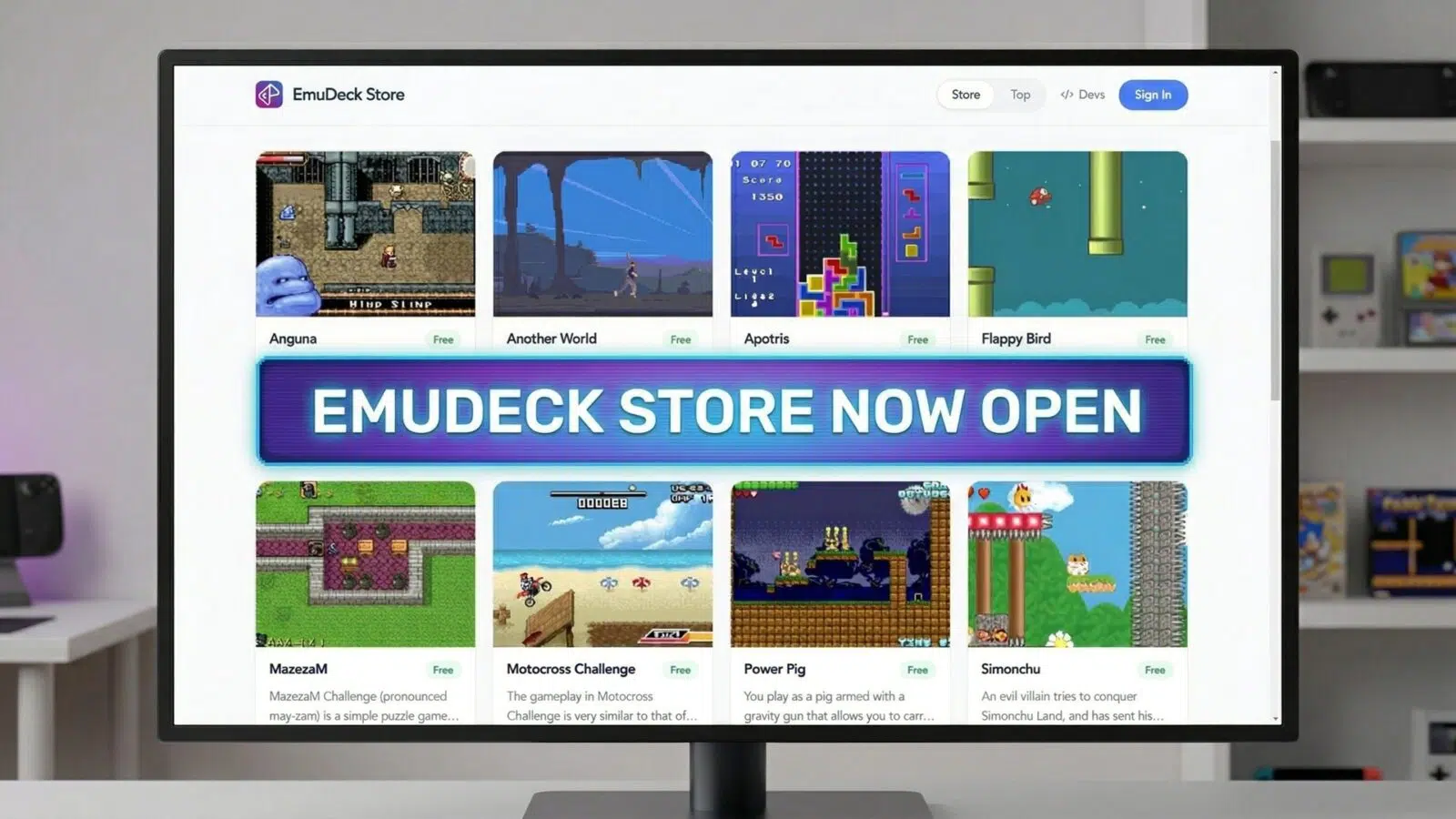
What is EmuDeck Store? EmuDeck Store is a storefront for retro homebrew games. It sits alongside the wider EmuDeck ecosystem, giving players a simpler way to discover, download, and manage original games for classic systems. It follows EmuDeck for Android’s beta rollout with a more content-focused follow-up aimed at collectors, tinkerers, and homebrew developers.
EmuDeck’s latest move is not another emulator profile or frontend tweak. It is a content play.
After the launch of EmuDeck for Android beta, the project has now pushed further into the retro ecosystem with the EmuDeck Store. It’s dedicated storefront for homebrew games and demos built for classic consoles. For Android gaming handheld & handheld gaming PC owners, that matters because a polished setup only becomes more valuable when it also helps users find new things to play.
That is the real angle here. EmuDeck is trying to reduce friction not only during setup, but also during discovery.
For anyone using modern Android handhelds such as the AYN Thor, AYN Odin 3, or AYANEO Pocket VERT, the idea is easy to understand. Once your emulation folders, BIOS paths, and frontend are in order, the next question is usually: what should I actually load onto this thing? EmuDeck Store attempts to answer that with a curated catalogue of homebrew titles that can be downloaded from one place.
The EmuDeck Store is about discovery as much as distribution
The EmuDeck Store is positioned as a cleaner route into the homebrew scene.
Retro homebrew has never lacked creativity, but it has often lacked visibility. Many projects live on scattered itch.io pages, GitHub repositories, forum posts, or personal developer websites. That works for enthusiasts who already know where to look, but it creates a barrier for newer users who have just finished setting up a handheld and want something legal, lightweight, and interesting to try straight away.
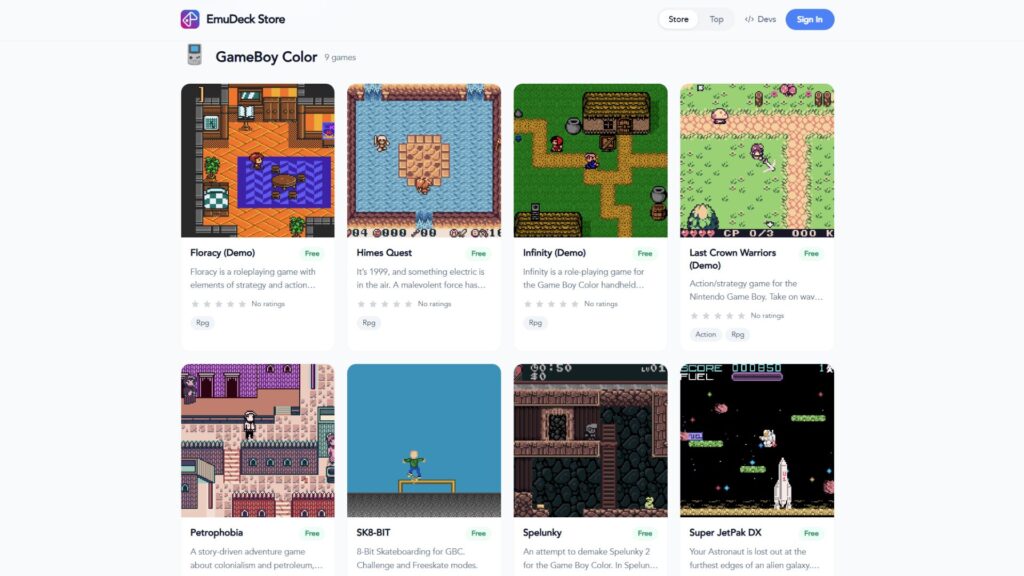
EmuDeck Store reduces that sprawl. Instead of asking users to search across multiple sites, it presents a single catalogue with platform categories, game pages, screenshots, and direct downloads for free titles. At the time of writing, the live catalogue lists 95 games or demos across nine categories, with only one paid title and the rest available free of charge.
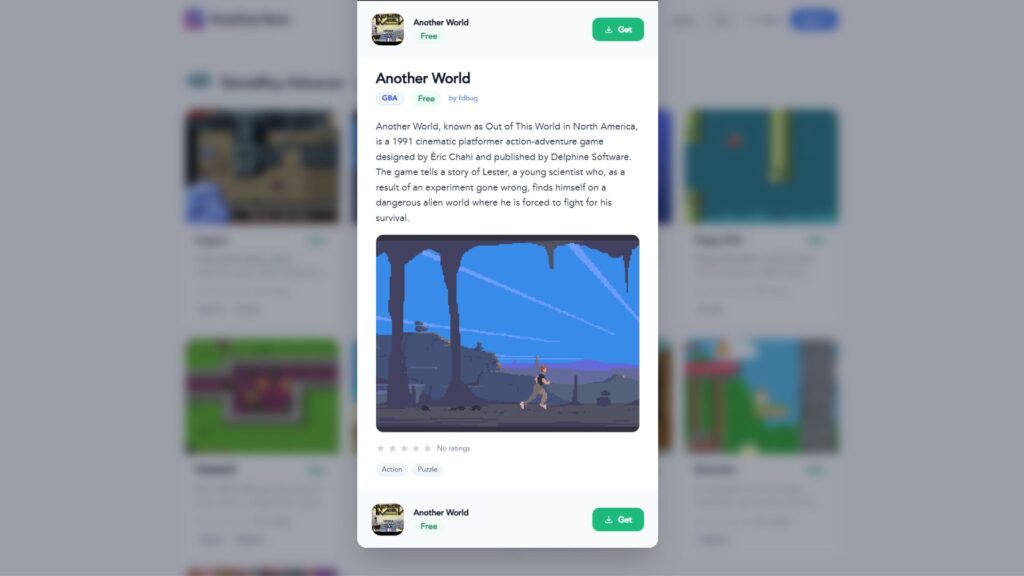
That split is important. The storefront is not being introduced as a premium-only marketplace. Right now it looks more like a discovery layer for retro homebrew, with paid releases added carefully rather than pushed aggressively.
What is on the store right now?
The current catalogue spans multiple classic systems and a broad mix of genres.
The strongest categories by volume are NES, Genesis, and Game Boy, but the catalogue also reaches across Game Boy Color, Game Boy Advance, Super Nintendo, Master System, Game Gear, and a small Nintendo 64 section.
| Platform category | Games listed at time of writing |
|---|---|
| NES | 22 |
| Genesis / Mega Drive | 19 |
| Game Boy | 12 |
| Super Nintendo | 10 |
| Game Boy Advance | 9 |
| Game Boy Color | 9 |
| Master System | 9 |
| Game Gear | 4 |
| Nintendo 64 | 1 |
A few examples help show the range. On the free side, the store currently lists titles such as Apotris for Game Boy Advance, Spelunky for Game Boy Color, Dangerous Demolition for Game Gear, Tobu and Tuff for the original Game Boy, and uCity for Game Boy Color. The only paid game listed at the time of writing is Glory Hunters, a $5 Game Boy action-adventure RPG built around achievement-driven progression.
That mixture gives the store a useful identity. It is not only a place for quick tech demos or novelty projects. There are puzzle games, platformers, arcade-style releases, demakes, action games, and at least one commercially sold title sitting next to the free material.
Why this matters after EmuDeck for Android beta
The EmuDeck Store feels like a natural second step after Android setup automation. In our earlier coverage of EmuDeck for Android beta, the big takeaway was convenience. EmuDeck wanted to cut down manual APK hunting, BIOS path errors, and frontend setup fatigue on devices such as the AYN Odin 3 and AYN Thor. The store extends that same convenience mindset into software discovery.
That makes particular sense on premium Android handhelds. Devices like the AYANEO Pocket VERT are excellent for short-session retro play. While more powerful handheld gaming PC hardware such as the GPD WIN 5 or ONEXPLAYER ONEXFLY Apex reward users who build diverse libraries across multiple generations. A storefront that points owners towards legal homebrew downloads is a practical complement to that hardware.
There is also a broader ecosystem angle here. If EmuDeck can make setup easier and content discovery easier, it becomes more than a utility. It becomes a gateway into the retro handheld hobby.
The developer pitch is just as important as the player experience
EmuDeck Store is also trying to solve a distribution problem for developers. According to the official developer FAQ, creators can apply for an account with their name, email, and portfolio or website, with approval usually taking 24 to 48 hours. Once approved, they can upload a zipped ROM, an in-game screenshot, title art, and optionally a short WEBM gameplay clip and transparent logo. Submitted games then go through review, where the store checks that the build runs properly, the screenshots match, and the content follows its guidelines.
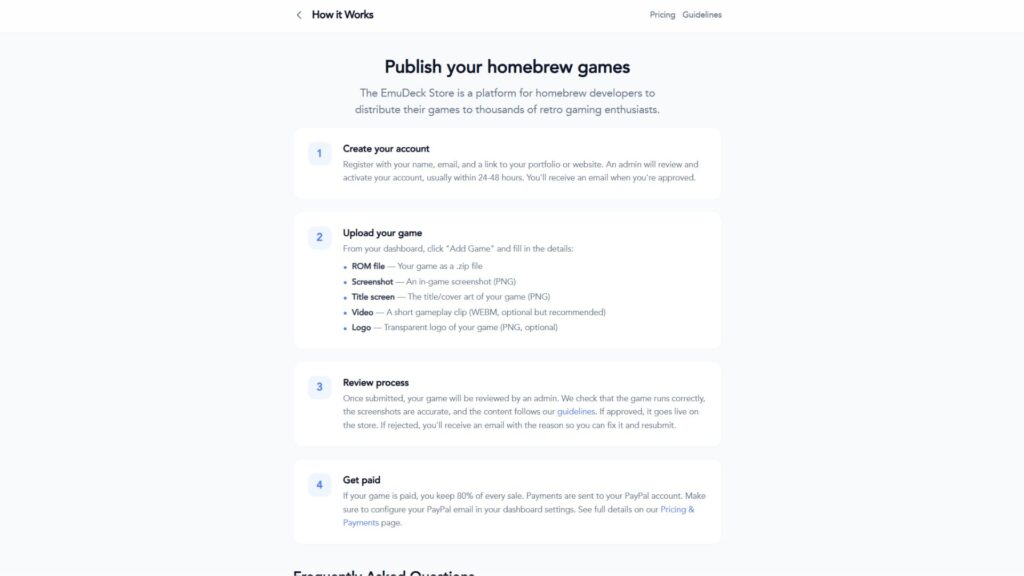
For paid releases, EmuDeck says developers keep 80% of each sale, with payouts sent through PayPal. Free games are also welcomed, and the FAQ notes that users can download those without creating an account.
That combination matters because it lowers the barrier on both sides. Players get a more centralised catalogue, while developers get a cleaner route to reach an audience that is already interested in retro software and handheld play. If that process stays quick and transparent, it could become one of the more useful small-scale distribution options in the homebrew scene.
The biggest question is whether the catalogue can keep growing
A storefront only stays relevant if it keeps adding worthwhile games. The early numbers are encouraging. Ninety-five titles is enough to make the store feel real rather than symbolic, and the spread across multiple systems gives it a wider appeal than a single-platform showcase. But momentum will matter more than launch size.
If EmuDeck can keep attracting polished homebrew releases, keep surfacing standout free projects, and maintain a smooth submission process for developers, the store could become a regular stop for retro handheld owners. If updates slow down or the catalogue becomes buried under low-effort uploads, the novelty could fade quickly.
For now, though, the project looks promising because it builds on a real need. Emulation users do not only need tools. They also need easy ways to discover legal software worth playing.
Our verdict — Is EmuDeck Store worth watching in 2026?
Short answer: Yes, especially if you already use EmuDeck or play on modern handheld gaming PCs and Android gaming handhelds.
Best for: Retro handheld owners who want quick access to legal homebrew and developers looking for another route to publish classic-format games.
Not ideal for: Players expecting a huge commercial catalogue or developers targeting systems outside the store’s currently named supported platforms.
Current status: Live storefront with 95 listed games or demos at time of writing, the vast majority free.
Rating: 8/10, based on live catalogue and published developer information checked in April 2026.
FAQ
What is EmuDeck Store?
EmuDeck Store is a storefront for retro homebrew games and demos that gives players a central place to discover and download new titles for classic systems. It expands the wider EmuDeck ecosystem beyond setup tools and into content discovery.
Are most games on EmuDeck Store free?
Yes, most of the current catalogue is free to download. At the time of writing, the live store lists 95 games or demos, with only one paid title, Glory Hunters, priced at $5.
What systems does EmuDeck Store support?
EmuDeck’s developer FAQ names Game Boy, Game Boy Color, Game Boy Advance, NES, SNES, Sega Genesis or Mega Drive, Sega Master System, and Game Gear as supported submission platforms. The live storefront also currently shows a small Nintendo 64 section.
Can developers publish their own games on EmuDeck Store?
Yes, developers can apply for an account, upload their game assets, and submit a title for review. EmuDeck says account approval usually takes 24 to 48 hours, reviews aim to finish within 48 hours, and paid developers keep 80% of each sale.